
Old Hampshire Mapped

Coats of Arms, Heraldry
NotesThe descriptions of coats of arms, the blazon, found in various sources do not all follow one strict pattern - so be wary of what is written in our notes about the arms found on maps - we've done our best with the information we've found!
The language used is formal and is meant to follow strict rules; it feels very familiar to a computer programmer! There is a limited vocabulary of terms telling you what to paint on the shield; the terms are half familiar half of the time - in heraldry many of the terms hark back to Norman French. The order of dealing with elements follows rules which enable the writer to take lots of connecting language for granted, leaving it out, which makes it harder for the novice to understand. This is just what many programming languages are like.

gules, six crowns flory, 3,2,1, or
can be understood as:- paint your shield gules ie red, then paint six 'flory' design crowns on it in or ie gold, arranged in three rows, 3 then 2 then 1.
(Notice the letters o and g in the engraving.)
- O, Or - or, gold, use yellow
- A, Ar, Arg - argent, silver
- G, Gu - gules, red
- Az, B - azure, blue
- V, Vt - vert, green
- P, Purp - purpure, purple
- S, Sa - sable, black
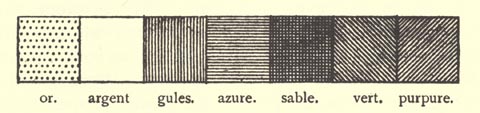
It is not unnown for the engraver, perhaps in the Netherlands, to get the hatching wrong. There is a mix up on Speed's map of Dorset for example, where the vertical and horizontal hatchings for red and blue, are transposed. This is not uncommon in dutch engraving.
Brooke-Little, J P: 1994: Royal Heraldry, Beasts and Badges of Britain: Pilgrim Press (Derby, Derbyshire):: ISBN 0 900594 59 4
Burke, John: 1847: Encyclopaedia of Heraldry; General Armory of England, Scotland and Ireland: Bohn, Henry (Covent Garden, London)
Foster, Joseph: 1994 (reprint) & 1902 (original): Dictionary of Heraldry: Studio Editions:: ISBN 1 85170 309 8
Fox-Davies, Arthur C: 1993 (reprint) & 1929 (original): Complete Guide to Heraldry & Some Feudal Coats of Arms: Bracken Books (London):: ISBN 1 85891 079 X
Longbottom, F W: 1982: Heraldry in the Windows of the Great Hall of Winchester Castle: (unpublished ms in Hampshire Library, Local Studies Collection)
Portal, Melville, Sir: 1899: Great Hall at Winchester: Warren (Winchester, Hampshire)
St George, Henry, Sir & Squibb, G D (ed): 1686; 1991 (edn): Visitation of Hampshire and the Isle of Wight 1686: Harleian Society (London)
Wagner, A R: 1961: Papworth's Ordinary of British Armorials: Tabard Publications (London):: which is arranged alphabetically by pictorial elements
Woollaston, Gerald Woods, Sir: 1960: Heraldry: Heraldry Society, The

